The CMMC landscape may be shifting, but waiting for every requirement to settle could leave defense contractors with a much bigger problem when certification becomes necessary.
Organizations that handle CUI still need to understand where that data lives, how it is protected, where security gaps exist, and whether they have the documentation to prove their controls are working.
During R3’s webinar, CMMC and the New Compliance Reality: Preparing for Certification Under Evolving DoD Requirements, R3’s compliance and technical experts broke down what contractors should be doing now to strengthen their readiness and prepare for assessment.
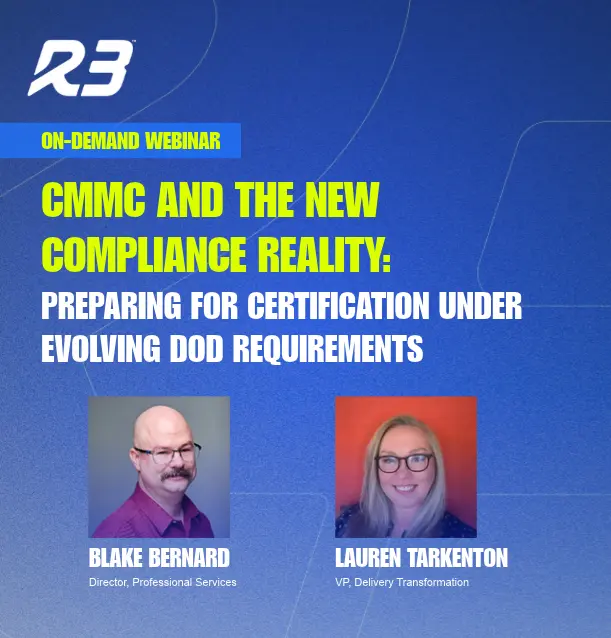
Watch the webinar on demand for the full conversation.
In the meantime, these are the key CMMC priorities organizations should have on their radar.
1. A CMMC Pause Doesn’t Mean Compliance Can Wait
CMMC is no longer coming. It’s here.
The DoD may adjust how and when third-party assessments are required, but organizations handling CUI still have obligations under applicable contract requirements. A pause in certain third-party assessment requirements does not remove the underlying security requirements.
Organizations should continue to:
- Review contracts and solicitations for applicable requirements.
- Assess their environment against NIST SP 800-171.
- Maintain an accurate SPRS (Supplier Performance Risk System) score.
- Address gaps through a Plan of Action and Milestones (POA&M).
- Collect evidence showing that required controls are working.
Waiting for every detail of CMMC implementation to settle can leave organizations scrambling when a requirement appears in a solicitation or contract.
2. Start With CUI and Get the Scope Right
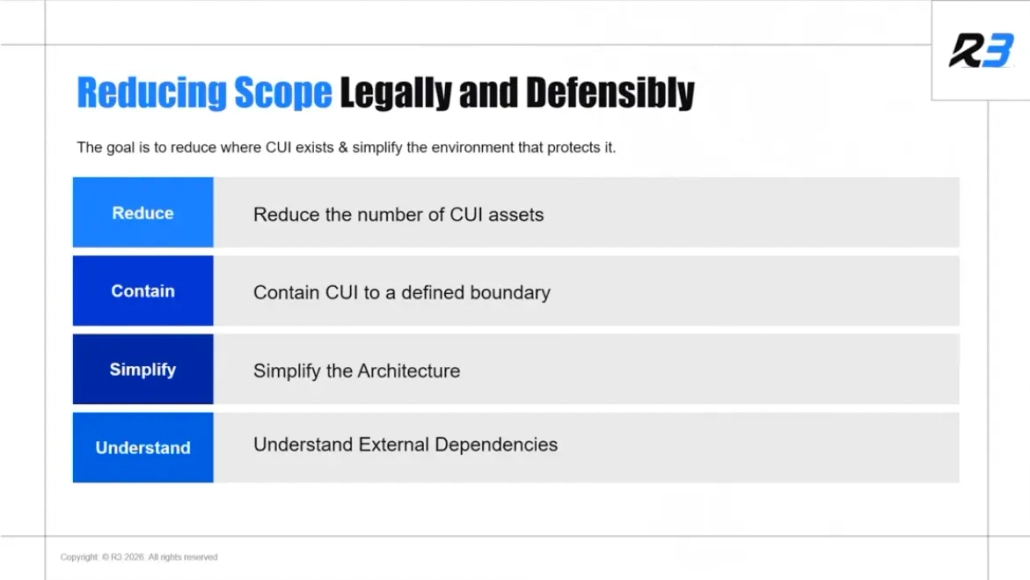
Before securing CUI, you need a clear picture of where it lives and who interacts with it. Defining that scope early helps keep the compliance boundary manageable and prevents unnecessary systems, users, and processes from being pulled into an assessment.
A well-defined CUI boundary can reduce:
- The number of assets subject to controls.
- The number of users in scope.
- The evidence required.
- The complexity of assessment preparation.
The goal is a boundary that protects CUI while supporting how your organization operates.
3. Choose a CMMC Architecture That Fits Your CUI
How you structure your CUI environment can significantly affect the size and complexity of your CMMC scope.
Some organizations may need a broader enterprise environment with a full GCCH migration, while others can isolate CUI within a dedicated GCCH enclave. Each approach carries different considerations for users, systems, workflows, controls, and assessment requirements.
The right approach depends on how CUI moves through your organization and how tightly you can contain it without disrupting the business.
4. Understand Where CMMC Service Providers Fit
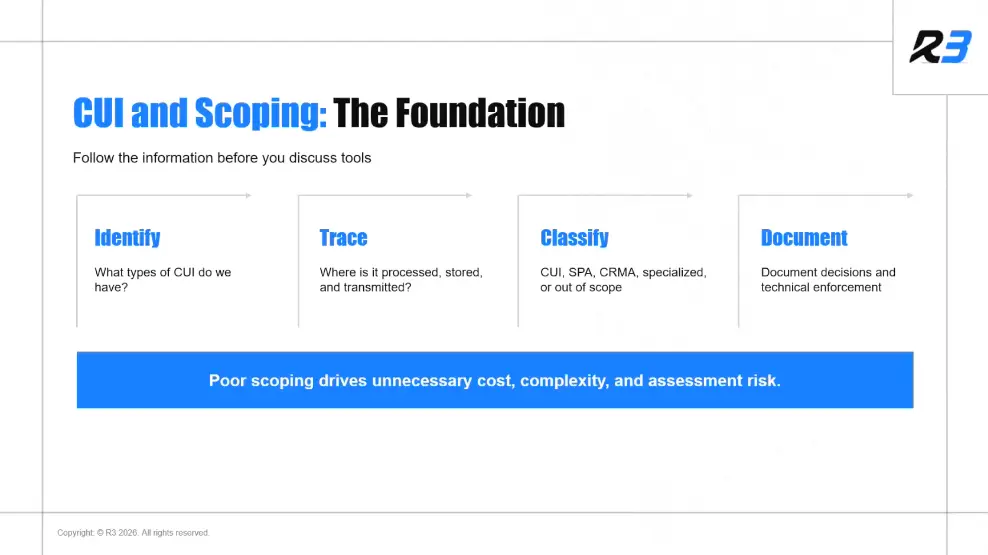
External providers can become part of your CMMC scope when their services store, process, transmit, or provide access to CUI.
Cloud providers, MSPs, MSSPs, backup platforms, and other technology partners should be considered when mapping your CUI flow and documenting control ownership.
Working with providers that already meet applicable requirements may allow your organization to inherit controls through a shared responsibility model. Your organization still needs to demonstrate how those requirements are satisfied and provide supporting evidence during an assessment.
5. CMMC Documentation Is Part of the Control
“The most important thing is to document it. Because if you didn’t write it down, it didn’t happen.”
- Blake Bernard, Director, Professional Services, R3
An organization can have strong technical controls and still struggle during an assessment if it cannot demonstrate how those controls operate.
Organizations should have evidence ready to support areas such as:
- Configuration management.
- Personnel screening.
- Security procedures.
- CUI handling.
- Training.
- Access controls.
- Changes to the environment.
Keeping that material organized can make the assessment much smoother.
At R3, we’ve seen assessments that would typically take three to four days completed in roughly a day to a day and a half when documentation and evidence were prepared upfront.
6. Prepare Your People for the Assessment
Assessors use three primary methods to evaluate readiness:
- Interview
- Examine
- Test
Your documentation, technical environment, and employees should all support the same story.
A control may work technically, but an employee who cannot explain the process or their responsibility can raise questions during an assessment. Training and clear ownership are critical parts of preparation.
Leadership has a role here, too. CMMC affects security, IT, HR, operations, compliance, and employees who handle CUI. Executive sponsorship gives those teams the authority, time, tools, and resources needed to follow a consistent program.
Build Your Path to CMMC Readiness
CMMC readiness comes down to knowing your scope, understanding your gaps, and being able to demonstrate that your controls are working as intended.
Taking those steps early gives your organization more time to address issues and prepare the documentation and evidence assessors will expect to see.
Get a clearer view of what CMMC readiness requires and where to focus your efforts next. Watch the full webinar on demand.